

What Active Labor Actually Feels Like & What’s Happening Inside
If early labor is the foundation of setting the tone for labor (as discussed in our last blog), then active labor is the bridge that organizes the body into rhythm and steady progress.
This is often the stage where things begin to feel real. This can often be the stage where mom’s (and partners) can begin to worry, or wonder if something is wrong. When intensity builds and no one has explained why, it’s easy to assume something is wrong. That labor is “too much.” That it’s moving too fast. Or not fast enough.
But active labor is not chaos. It is coordination.
What is Active Labor?
Active labor is when the body shifts from preparation into coordination. This is often the stage where your body says: “Nope. Not resting anymore.”
Contractions become harder to ignore.
They demand your attention.
You don’t want to chat through them.
You close your eyes.
You move instinctively.
This shift is very normal, in fact, it’s productive!
So what is happening physiologically?
In active labor, several important things are happening at once: The uterus is coordinating, instead of irregular warm-up waves, contractions become more rhythmic and powerful. The top of the uterus thickens and pulls upward, helping open the cervix below. This coordination is what creates steady dilation. The cervix is actively thinning and opening. Effacement (softening of the cervix) and dilation continue, but now they tend to progress more consistently as contractions organize into a pattern. Oxytocin is rising. This hormone drives contractions, but it also thrives in safety and support. As labor intensifies, the body needs protection from stress and interruption so oxytocin can continue building. Endorphins increase. Your body releases natural pain-relieving hormones to help you cope. This is one reason women often become quiet, inward, or deeply focused during active labor. Baby is rotating and descending. With each contraction, your baby moves deeper into the pelvis, adjusting position as needed. This is part of why sensations feel stronger, the baby is moving and working with the contraction.
Active labor feels intense because it is organized. The body is no longer warming up. It is working with purpose.
How do we best support active labor?
This is where we like say: “We’ll be active about active labor.” Ideally, you’ve rested in early labor. You ate. You hydrated. You conserved energy. Now your body is asking for engagement.
Support in active labor often looks like:
Movement with intention
Swaying through contractions
Slow walking or lunging
Hip circles on a birth ball
Leaning forward over a counter or bed
Movement creates space in the pelvis and supports baby’s descent. As birth doulas, we are trained to watch your intuitive movements, and let that guide us into position ideas. The way your body naturally moves can often communicate to us where the baby is potentially trying to navigate through your pelvis, and what positions we can best use to open up more space for baby to do their cardinal movements.
Releasing tension
Relaxing the jaw, shoulders, and hands
Low, steady vocalization
Slow breathing that matches the wave
When the jaw softens, the pelvic floor often softens too. Tension can slow progress. Softness creates space. Tension also can inhibit our endorphins from working optimally (the hormone which helps us cope with the pain of labor). As much as possible, we try to cue you into body postures, breath work, mindset spaces, that can ultimately lead to the release of tension you might be holding onto.
Protecting the environment
Dim lights
Fewer questions
Minimal interruptions
Steady, calm presence
Active labor is not the time for performance or conversation. It’s the time for inward focus and surrender. We want to keep you out of your “thinking brain” as much as possible. Physiologically this matters very much. The “thinking brain” (the neocortex) is responsible for logic, language, decision-making, and social interaction. When it becomes highly active, it can interrupt the hormonal flow of labor. Labor is primarily directed by the more primitive, instinctive parts of the brain (the limbic system and brainstem ), which regulate oxytocin and automatic bodily processes. This is why we want to. “protect the environment”.
Why Does Fear Often Show Up Here?
Active labor can be a stage where fear creeps in. If no one has explained that this shift is normal, the nervous system can interpret intensity as danger. And when the brain senses danger, it activates protection.
The Fear Tension Pain Cycle
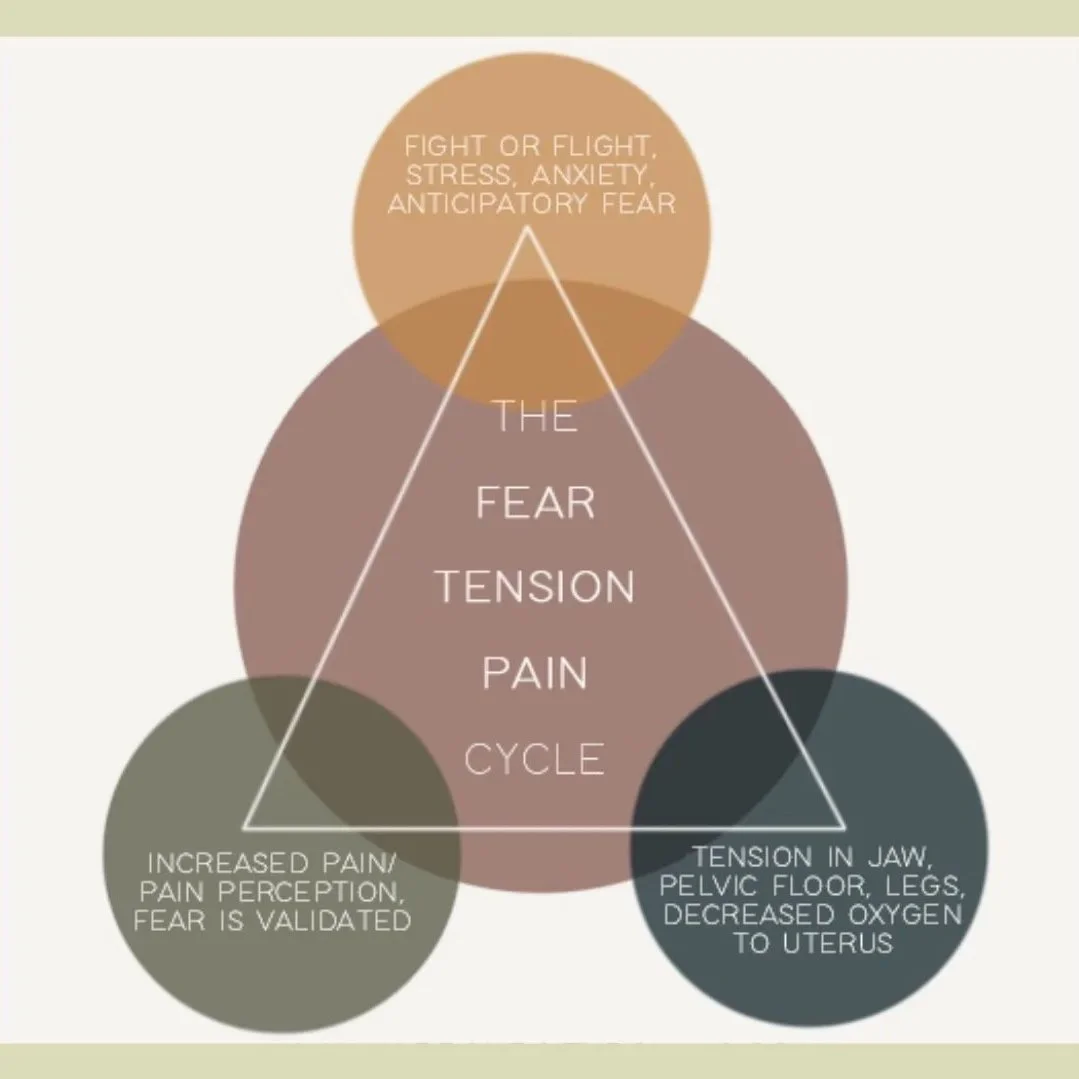
You may have seen the fear–tension–pain triangle. It works like this:
Fear → creates tension
Tension → increases resistance in the body
Resistance → amplifies pain
And amplified pain → reinforces fear.
It becomes a loop. When fear rises, the body often tightens, especially in the jaw, shoulders, abdomen, and pelvic floor. That tension works against the opening and softening that labor requires. At the same time, fear activates the stress response. Adrenaline increases. Muscles brace. Breathing becomes shallow.
And here’s where physiology matters:
Endorphins (your body’s natural pain-relieving hormones) work best when a woman feels safe and able to surrender. If you are clenching, bracing, or holding her breath, endorphins cannot circulate as effectively. This validates the fear. Because when tension increases, pain truly does feel stronger. The fear wasn’t imagined, but it also wasn’t the root of the problem, tension was.
Addressing Fear First
This is why we work from the top of the triangle. If we can reduce fear (through education, reassurance, and understanding what’s happening inside the body) we often prevent the tension that intensifies pain.
When you can understand:
why contractions are stronger
why you may shake or vocalize
why the work feels demanding
The sensation still exists, but it doesn’t feel as scary. You have prepared and know what is coming. It will still surprise you but not in a way that brings panic, but in a way you can open and surrender to knowing you are safe, and this is normal. The body can work with labor instead of bracing against it.
This is often when we show up
Active labor is often the stage where we arrive. Not because something is wrong, but because this is when the work deepens. This is the moment when intensity rises. When doubt can surface. When partners look at each other and wonder, “Is this normal?” And this is exactly why we prepare the way we do. All of the prenatal conversations, the education, the mindset work, the practice of breathing and releasing tension, the understanding of hormones and physiology. It’s not extra, but foundational.
Because when active labor builds, we’re not scrambling to figure it out. We’re building on trust that’s already been established. We remind you that this shift is normal, that your body is organizing, that intensity has purpose, that nothing is going wrong! We steady your partner so they can steady you.
Education is foundational to us at Ezer Birth because it truly changes how labor is experienced. When you understand what’s happening inside your body, you approach intensity differently. And when your partner understands it too, they stop looking for problems to fix, and start becoming a source of calm and reassurance.
Active labor is powerful. But it does not have to be chaotic.
With preparation, understanding, and steady support, it becomes purposeful.
And that makes all the difference.